
How to Calculate Pipe Fall from Length and Slope
A practical guide to calculating total pipe fall from a measured run and slope in imperial or metric units.
6 mins read
To calculate pipe fall, multiply the horizontal run by the slope. The units must match the way the slope is written: feet with inches per foot, a same-unit run with percent, or meters with millimeters per meter.
Quick formula
Total fall = run length × slope
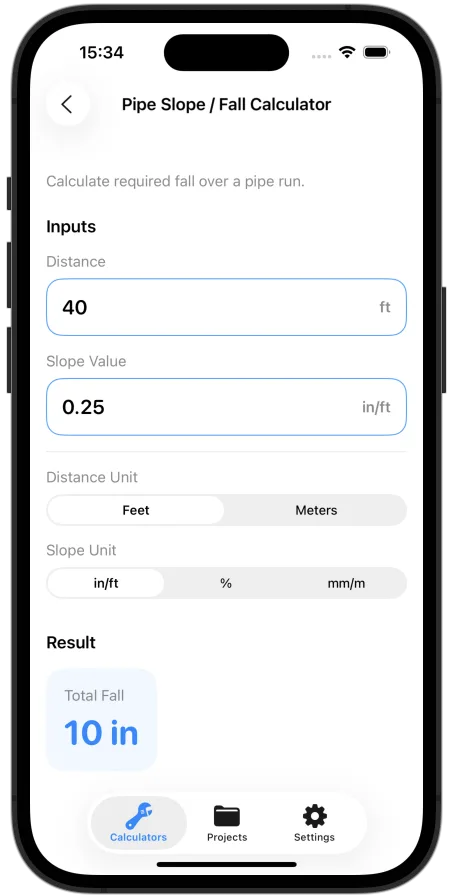
For example, a 40-foot run at 1/4 inch per foot has 10 inches of total fall: 40 × 0.25 = 10.
Run, slope, and fall are different measurements
Run is the horizontal distance between the start and end points. Slope is the rate of vertical change over that distance. Fall is the total vertical drop from one end of the run to the other.
The calculation tells you the elevation difference implied by the slope and measured run. It does not choose the slope that applies to a particular pipe, system, or jurisdiction.
Pipe-fall formulas by slope unit
Inches per foot
Fall (inches) = run (feet) × slope (in/ft)
Percent
Fall = run × slope percent ÷ 100
Millimeters per meter
Fall (mm) = run (m) × slope (mm/m)
Percent slope is a ratio, so the run and fall initially use the same length unit. A 2% slope over 8 meters gives 0.16 meter of fall, which is 160 millimeters. If the run is measured in feet, the initial answer is in feet and can be converted afterward.
Worked examples
Imperial example: 40 feet at 1/4 inch per foot
- Write 1/4 inch as 0.25 inch.
- Multiply the 40-foot run by 0.25 inch per foot.
- 40 ft × 0.25 in/ft = 10 inches of fall.
Using the exact relationship of 25.4 millimeters per inch, 10 inches is 254 millimeters.
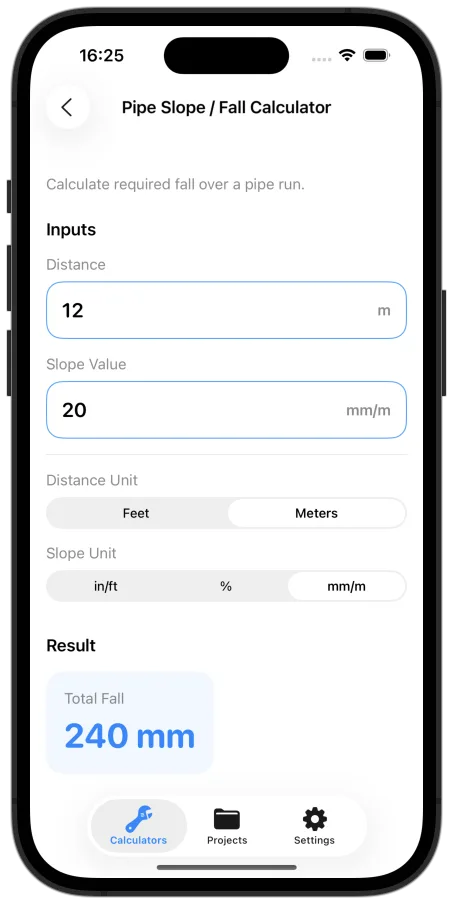
Metric example: 12 meters at 20 millimeters per meter
- Keep the run in meters because the slope is stated per meter.
- Multiply 12 meters by 20 millimeters per meter.
- 12 m × 20 mm/m = 240 millimeters of fall.
The same fall can be written as 0.24 meter.
How to avoid common calculation mistakes
- Use the horizontal run. A measurement taken along a sloped pipe is not exactly the same as its horizontal run.
- Keep the slope denominator visible. “1/4 inch per foot” means 1/4 inch for every foot, not 1/4 inch for the entire run.
- Convert units deliberately. Do not multiply a run in meters by an in/ft slope without converting one side first.
- Round at the end. Keep extra precision during the calculation, then round to a level appropriate for the measurement method and job.
- Check direction and endpoints. Confirm which point is upstream, which is downstream, and where each elevation is measured.
Calculate pipe fall on iPhone
The free Pipe Slope / Fall tool in Plumbing Calculator & Tools accepts a positive run in feet or meters and a slope in inches per foot, percent, or millimeters per meter. It calculates the total fall and displays imperial and metric equivalents.
You can copy or share the result as text, or save a valid calculation with an optional note inside a project for later reference.
Check the inputs, then keep the result with the job
Use the free slope calculator to enter the measured run and chosen slope. Review the calculated fall, then verify it against the applicable requirements and site conditions.
View Plumbing Calculator on the App StoreWhat to record with the calculation
- The measured horizontal run and its unit.
- The slope value, slope unit, and source of the requirement.
- The calculated total fall and any rounding used.
- The upstream and downstream reference points.
- The code edition, drawing, specification, manufacturer guidance, or professional instruction used for verification.
- Any site condition that could affect the final layout or measurement.
Sources
- NIST: SI Units — Length — exact inch-to-millimeter relationship.
- International Code Council: 2021 IPC Section 704.1 — model-code example of slope provisions for horizontal drainage piping.
- New York City Plumbing Code: Section 704.1 — jurisdiction-specific example showing why the applicable local code must be checked.