
Pipe Slope Calculator Guide: Inches per Foot, Percent, and mm/m
Learn what in/ft, percent, and mm/m mean, how to convert them, and how to enter the right slope unit for a pipe-fall calculation.
7 mins read
Pipe slope can be entered as inches per foot, percent, or millimeters per meter. All three describe the same relationship—vertical change divided by horizontal run—but each uses a different scale. Choose the unit written on the drawing or requirement, keep the run unit compatible, and convert only when you need to compare values.
Quick equivalence
2% = 20 mm/m = 0.24 in/ft
The inches-per-foot value is rounded to two decimal places. More precisely, 2% equals 0.24 in/ft exactly because one foot contains 12 inches.
What each pipe-slope unit means
Inches per foot (in/ft)
The number of vertical inches gained or lost for every horizontal foot. A slope of 0.25 in/ft changes elevation by one-quarter inch per foot of run.
Percent (%)
The vertical change divided by the horizontal run, multiplied by 100. A 2% slope changes elevation by 2 units for every 100 of the same units.
Millimeters per meter (mm/m)
The number of vertical millimeters gained or lost for every horizontal meter. A slope of 20 mm/m changes elevation by 20 millimeters per meter of run.
The run is the horizontal distance, not the distance measured along the sloping pipe. The U.S. Geological Survey defines percent slope from elevation change divided by horizontal distance, multiplied by 100.
Pipe-slope conversion formulas
| Convert | Formula | Example |
|---|---|---|
| in/ft to percent | in/ft ÷ 12 × 100 | 0.25 ÷ 12 × 100 = 2.0833% |
| Percent to in/ft | percent ÷ 100 × 12 | 2 ÷ 100 × 12 = 0.24 in/ft |
| mm/m to percent | mm/m ÷ 10 | 20 ÷ 10 = 2% |
| Percent to mm/m | percent × 10 | 2 × 10 = 20 mm/m |
These formulas follow directly from 12 inches in one foot and 1,000 millimeters in one meter. NIST defines one inch as exactly 25.4 millimeters and one international foot as exactly 0.3048 meter, which also gives 1 in/ft = 83.3333 mm/m.
Worked example: the same slope in three units
10-meter run at 2%
- Convert the percent to a decimal ratio: 2 ÷ 100 = 0.02.
- Multiply the horizontal run by the ratio: 10 m × 0.02 = 0.2 m.
- Convert meters to millimeters: 0.2 m × 1,000 = 200 mm of total fall.
The slope input could also be written as 20 mm/m or 0.24 in/ft. Using any of those equivalent inputs should describe the same idealized slope before display rounding.
Which slope unit should you enter?
- Match the source. If a drawing or verified requirement states in/ft, percent, or mm/m, enter that unit directly instead of converting it first.
- Match the run where practical. Feet pair naturally with in/ft, while meters pair naturally with mm/m. Percent works with any length unit because it is a ratio.
- Keep precision while converting. A quarter inch per foot is approximately 2.0833%, not exactly 2%. Rounding it to 2% changes the calculated fall.
- Record the original unit. Keep the value and unit from the drawing or requirement with the calculation so another person can reproduce it.
Use the free pipe-slope calculator on iPhone
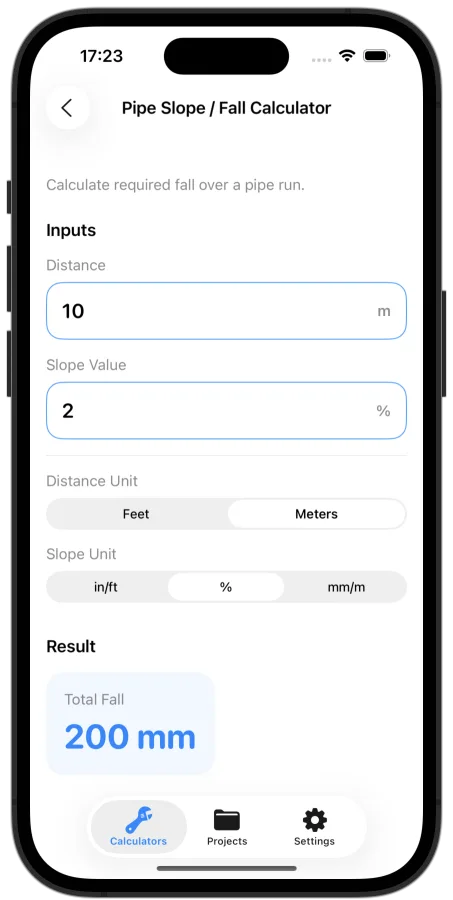
The Pipe Slope / Fall tool in Plumbing Calculator & Tools accepts a positive distance in feet or meters and a positive slope in in/ft, percent, or mm/m. It calculates total fall and displays metric and imperial equivalents.
For the worked example above, enter 10 meters and 2%. The calculated total fall is 200 millimeters. You can copy or share a valid result as text, or save it with an optional note inside a project.
Use the unit you were given
Enter the measured run and the verified slope without doing a separate conversion first, then review the calculated fall and equivalent units.
View Plumbing Calculator on the App StoreContinue with total fall
Once the slope unit is clear, use the measured run to calculate the total elevation change. See How to Calculate Pipe Fall from Length and Slope for imperial and metric fall formulas, worked examples, and measurement checks.
Sources
- U.S. Geological Survey: To Determine Percent of Slope and Angle of Slope — percent slope as elevation change divided by horizontal distance, multiplied by 100.
- NIST: SI Units — Length — exact inch-to-millimeter relationship.
- NIST: U.S. Survey Foot — international-foot definition of exactly 0.3048 meter.