
How to Convert mm per Meter to Percent Slope
Convert millimeters per meter to percent slope, reverse the calculation, and check the resulting fall over a measured pipe run.
6 mins read
To convert millimeters per meter (mm/m) to percent slope, divide the mm/m value by 10. For example, 20 mm/m is a 2% slope: 20 ÷ 10 = 2. To convert percent back to mm/m, multiply by 10.
Conversion formulas
Percent slope = mm/m ÷ 10
mm/m = percent slope × 10
These formulas convert the magnitude of the slope. They do not determine which end of the pipe is higher or which slope a project requires.
Why dividing by 10 works
Millimeters per meter compares a vertical change in millimeters with a horizontal run in meters. Percent slope compares the change and run in the same unit, then multiplies that ratio by 100.
20 mm/m = 20 mm of change per 1,000 mm of horizontal run
20 ÷ 1,000 = 0.02
0.02 × 100 = 2%
Because one meter contains 1,000 millimeters, the complete calculation is mm/m ÷ 1,000 × 100. That simplifies to mm/m ÷ 10.
Worked example: 20 mm/m over a 12-meter run
First convert the slope
- Divide the slope by 10: 20 ÷ 10 = 2.
- Therefore, 20 mm/m and 2% describe the same idealized slope.
Then check the total fall
Using mm/m: 12 m × 20 mm/m = 240 mm.
Using percent: 12 m × 2 ÷ 100 = 0.24 m, and 0.24 m × 1,000 = 240 mm. Both calculations give the same total fall.
mm/m-to-percent conversion table
| Slope (mm/m) | Calculation | Percent slope |
|---|---|---|
| 5 mm/m | 5 ÷ 10 | 0.5% |
| 10 mm/m | 10 ÷ 10 | 1% |
| 12.5 mm/m | 12.5 ÷ 10 | 1.25% |
| 20 mm/m | 20 ÷ 10 | 2% |
| 25 mm/m | 25 ÷ 10 | 2.5% |
| 50 mm/m | 50 ÷ 10 | 5% |
These are mathematical conversions, not recommended slopes. Preserve the precision of the source value and round only as far as the measurement method and project documentation justify.
Common conversion mistakes
- Do not read mm/m as a total fall. A value such as 20 mm/m is a rate per meter; the total fall also depends on the horizontal run.
- Use the horizontal run. Percent slope is based on horizontal distance, not the slightly longer distance measured along the sloping pipe.
- Do not multiply when converting to percent. Divide mm/m by 10. Multiplication by 10 is the reverse conversion from percent to mm/m.
- Keep percent and degrees separate. Percent slope is a ratio, while degrees measure an angle. They are not numerically interchangeable.
- Keep direction with the job notes. A positive slope magnitude alone does not identify the high and low endpoints.
Check the resulting fall on iPhone
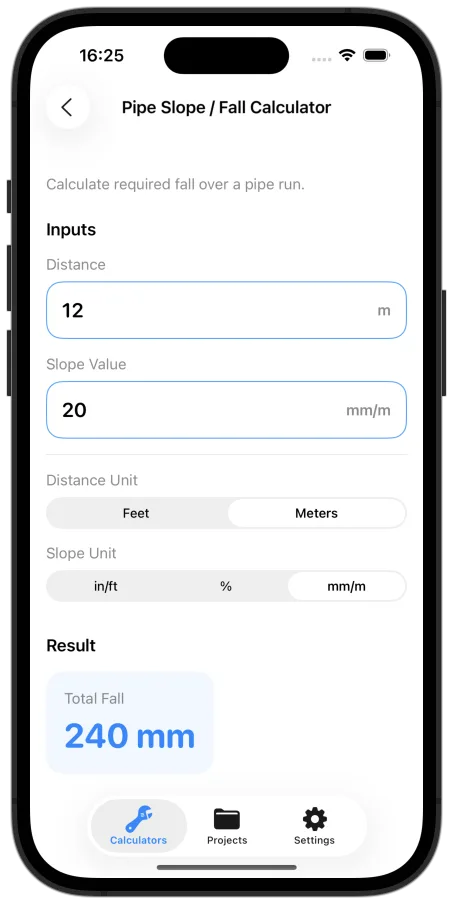
The free Pipe Slope / Fall tool in Plumbing Calculator & Tools accepts a positive run in feet or meters and a positive slope in in/ft, percent, or mm/m. Enter the original value as mm/m to avoid an unnecessary conversion, then compare the calculated total fall with your manual check.
For the worked example, enter 12 meters and 20 mm/m. The app calculates 240 millimeters of total fall. You can copy or share a valid result as text, or save it with an optional note inside a project.
Convert the slope, then verify the fall
Keep the original mm/m value with the job notes, check the percentage conversion, and use the free calculator to review the fall over the measured run.
View Plumbing Calculator on the App StoreWhat to record
- The original mm/m value and where it came from.
- The measured horizontal run and its unit.
- The converted percent and any rounding used.
- The calculated total fall and the high and low reference points.
- The drawing, specification, local requirement, or professional instruction used to verify the slope.
Continue with pipe-slope calculations
Use the Pipe Slope Calculator Guide to compare mm/m with inches per foot and percent. When you need the total elevation change, see How to Calculate Pipe Fall from Length and Slope.
Sources
- U.S. Geological Survey: To Determine Percent of Slope and Angle of Slope — defines percent slope as elevation change divided by horizontal distance, multiplied by 100.
- NIST: SI Units — Length — states that one meter equals 1,000 millimeters.