
How to Convert Pipe Slope from Inches per Foot to Percent
Use a unit-safe formula to convert inches per foot to percent slope, then verify the resulting fall over a measured pipe run.
6 mins read
To convert pipe slope from inches per foot to percent, divide the inches-per-foot value by 12, then multiply by 100. For example, 0.3 in/ft is a 2.5% slope: 0.3 ÷ 12 × 100 = 2.5.
Conversion formula
Percent slope = in/ft ÷ 12 × 100
Because one foot contains 12 inches, the division puts the vertical change and horizontal run in the same unit before the ratio is expressed as a percentage.
Why the conversion uses 12
A slope written in inches per foot compares a vertical change in inches with a horizontal run in feet. Percent slope compares the change and run in the same unit, then multiplies that ratio by 100.
Start by rewriting one foot as 12 inches:
0.3 in/ft = 0.3 inches of change per 12 inches of horizontal run
0.3 ÷ 12 = 0.025
0.025 × 100 = 2.5%
This follows the standard definition of percent slope: vertical change divided by horizontal distance, multiplied by 100.
Worked example: 0.3 in/ft over a 20-foot run
First convert the slope
- Divide the slope by 12: 0.3 ÷ 12 = 0.025.
- Multiply by 100: 0.025 × 100 = 2.5%.
- Therefore, 0.3 in/ft and 2.5% describe the same idealized slope.
Then verify the total fall
Using inches per foot: 20 ft × 0.3 in/ft = 6 inches.
Using percent: 20 ft × 2.5 ÷ 100 = 0.5 foot, and 0.5 foot × 12 = 6 inches. Both paths give the same total fall.
Common in/ft-to-percent conversions
| Slope (in/ft) | Calculation | Percent slope |
|---|---|---|
| 0.125 (1/8) | 0.125 ÷ 12 × 100 | 1.0417% |
| 0.25 (1/4) | 0.25 ÷ 12 × 100 | 2.0833% |
| 0.3 | 0.3 ÷ 12 × 100 | 2.5% |
| 0.5 (1/2) | 0.5 ÷ 12 × 100 | 4.1667% |
The four-decimal values are rounded. Keep more precision during intermediate calculations when the run is long enough for rounding to materially change the total fall.
Avoid these conversion mistakes
- Do not multiply by 100 before matching units. The vertical change is in inches while the run denominator is initially in feet.
- Do not treat 1/4 in/ft as exactly 2%. It is approximately 2.0833%. A true 2% slope is 0.24 in/ft.
- Use horizontal run. Percent slope is based on horizontal distance, not the longer distance measured along the sloping pipe.
- Keep the direction separate from the magnitude. The percentage states how steep the slope is; job layout determines which endpoint is higher.
- Round at the end. Early rounding can produce a different fall when multiplied across the full run.
Check the resulting fall on iPhone
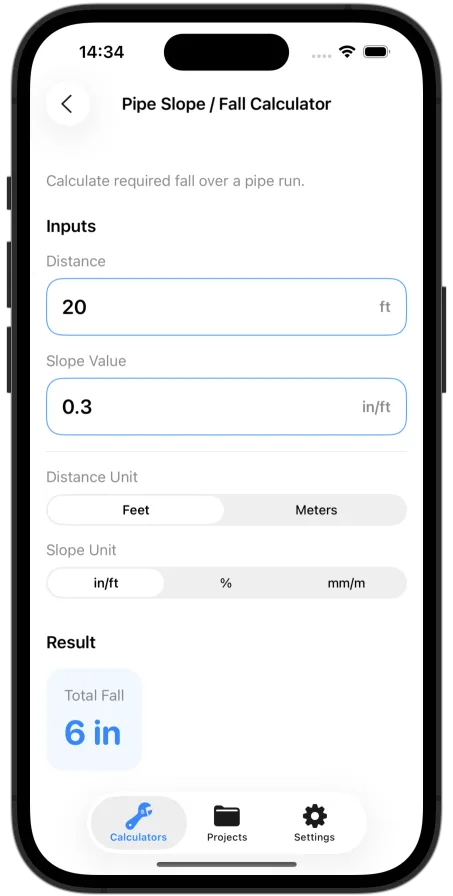
The free Pipe Slope / Fall tool in Plumbing Calculator & Tools accepts a positive run in feet or meters and a positive slope in in/ft, percent, or mm/m. Enter the slope in the unit you were given and compare the calculated total fall with your manual conversion.
For this example, enter 20 feet and 0.3 in/ft. The app calculates 6 inches of total fall. You can copy or share a valid result as text, or save it with an optional note inside a project.
Convert the slope, then check the fall
Keep the original slope unit with your notes, verify the percentage conversion, and use the free calculator to check the resulting fall over the measured run.
View Plumbing Calculator on the App StoreContinue with pipe fall and slope units
Use How to Calculate Pipe Fall from Length and Slope when you need the total elevation change over a run. For conversions among all three supported slope units, see the Pipe Slope Calculator Guide.
Sources
- U.S. Geological Survey: To Determine Percent of Slope and Angle of Slope — defines percent slope as elevation change divided by horizontal distance, multiplied by 100.
- NIST: SI Units — Length — provides the exact inch-to-millimeter relationship.
- NIST: U.S. Survey Foot — identifies the international foot as exactly 0.3048 meter.