
Pipe Slope vs Fall vs Grade: What Is the Difference?
Slope and grade describe a rate; fall is the total drop over a measured run. See how the terms connect in a checked example.
6 mins read
Slope describes how quickly elevation changes along a run. Grade is another way to express that rate, often as a percentage. Fall is the total vertical drop between two points. A 2% downhill grade stays 2% whether the run is short or long, but the total fall grows with the run length.
| Term | What it tells you | Example |
|---|---|---|
| Slope | Vertical change per unit of horizontal run | 20 mm/m |
| Grade | The same rate expressed as a ratio or percentage | 2% |
| Fall | Total vertical drop over the stated run | 200 mm over 10 m |
Slope and grade describe a rate
The underlying ratio is vertical change divided by horizontal distance. Multiply that ratio by 100 to express it as percent grade. In pipe work, the same rate may instead be written as millimeters per meter (mm/m) or inches per foot (in/ft). The unit label matters: 2% and 2 degrees are different measurements.
Rate and total change
Percent grade = vertical change ÷ horizontal run × 100
Total fall = horizontal run × (percent grade ÷ 100)
For a downhill pipe, “fall” refers to the magnitude of the drop. A drawing must still identify the high and low ends. A slope number alone does not tell you which way the pipe runs.
Worked example: 10 meters at 2% grade
Assume a straight run measured horizontally between the intended endpoints. The specified grade is 2%, and the pipe falls toward the downstream end.
- Convert the rate: 2% ÷ 100 = 0.02.
- Calculate fall: 10 m × 0.02 = 0.20 m.
- Convert the result: 0.20 m × 1,000 mm/m = 200 mm.
The grade is 2%; the fall over this 10 m run is 200 mm. The equivalent rate is 20 mm/m because 2% of 1,000 mm is 20 mm. The 200 mm total is not a slope unit.
If the horizontal run were 5 m at the same 2% grade, the fall would be 5 m × 0.02 = 0.10 m, or 100 mm. Doubling the run doubles the total fall while the grade stays 2%.
How to read the terms on a plan
- “2% grade” or “20 mm/m slope” gives a rate. You still need the horizontal run to calculate the total fall.
- “200 mm fall” gives a total drop. You still need the horizontal run to work out the grade.
- “2% fall” mixes a rate with a total-change word. Check the drawing or specification to see whether it means 2% slope or a stated drop over a particular distance.
Use the same reference points for the run and elevation change. Measuring along the sloping pipe instead of horizontally changes the ratio. Check whether a plan states a nominal rate, a minimum rate, or a pair of required elevations before using a calculated drop.
Calculate the fall on iPhone
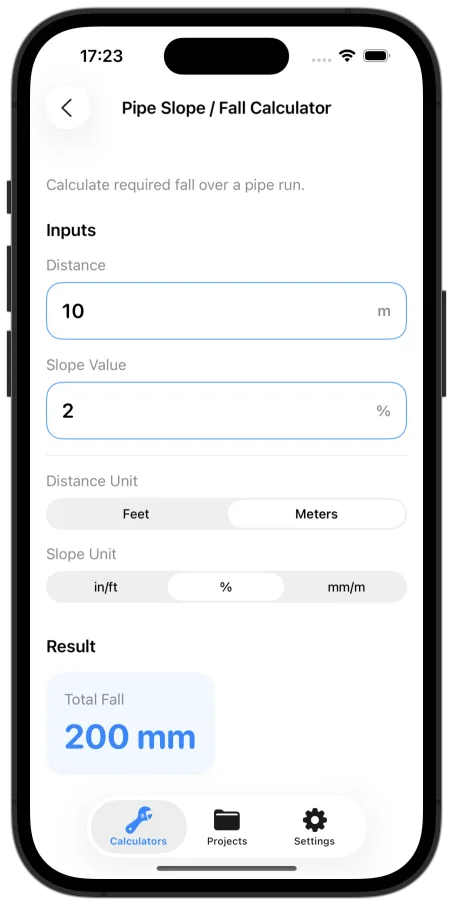
The free Pipe Slope / Fall tool in Plumbing Calculator & Tools accepts a positive run in feet or meters and a positive slope in percent, in/ft, or mm/m. For the example above, enter 10 meters and 2%. The calculated total fall is 200 millimeters. Check that the run, slope unit, and result match your hand calculation.
You can copy or share a valid slope result as text, or save it with an optional note in a project. Record which endpoint is high, because the calculator gives the amount of fall rather than the physical direction of the run.
Turn a slope into a total fall
Enter the horizontal run and the stated slope in the free calculator, then verify the result against the job requirements.
View Plumbing Calculator on the App StoreWhat to record
- Horizontal run, units, and measurement endpoints.
- Original slope or grade value and its unit.
- Calculated total fall, output unit, and any rounding.
- High and low endpoints and the drawing or requirement used to verify the layout.
Related guides
For the full calculation from run and slope, see How to Calculate Pipe Fall from Length and Slope. To compare percent with in/ft and mm/m inputs, read the Pipe Slope Calculator Guide.
Sources
- U.S. Geological Survey: To Determine Percent of Slope and Angle of Slope — defines percent slope using elevation change and horizontal distance.
- Federal Highway Administration: Bridge Geometry Manual — defines vertical grade as rise over run and expresses it as a percentage.
- NIST: SI Units — Length — provides the meter-to-millimeter relationship used in the example.